

Choosing the correct heavy-duty tire patches requires more than just finding the right diameter. The ply rating of a patch must match the structural strength and load category of the tire it is repairing. A common misconception is that a thicker, higher-ply patch is always a stronger repair. In reality, a patch that is too stiff for the casing can create localized stress, leading to edge lifting and premature failure. The correct choice is the one that matches the tire’s construction, not the one that simply looks the thickest.
Key Takeaways
- Ply rating is a measure of strength, not just thickness. It indicates the number of reinforced fabric layers in the patch.
- Match the patch to the tire’s load category. Passenger tires require lighter patches, while commercial tires need heavier units.
- A higher ply rating is not always better. Overly stiff patches can cause stress concentrations and edge lift on flexible casings.
- Radial tires require radial-specific patches. The reinforcement angles must align with the casing’s cord geometry.
- Standard ranges: 1-ply to 2-ply for passenger/light truck, and 3-ply to 4-ply for heavy commercial and OTR tires.
What Ply Rating Means in a Tire Patch
Ply Count vs. Patch Thickness
Historically, “ply” referred to the number of cotton fabric layers in a tire’s body. Today, it represents a standardized strength index. In a tire patch, the ply rating indicates how many layers of reinforced textile or steel cord are embedded in the patch body.
A 1-ply patch has a single reinforcement layer, making it thinner and more flexible. A 4-ply patch has multiple layers, making it thicker and more resistant to high pressure. While a higher ply patch is physically thicker, the ply rating is primarily a measure of tensile strength and puncture resistance, not just bulk.
How Ply Rating Maps to Tire Load Category
The ply rating of the patch must correspond to the service demands of the tire. A heavy commercial truck tire operates at much higher inflation pressures and carries significantly more weight than a passenger car tire. The patch must be able to withstand these forces without deforming.
If you use a light 1-ply patch on a heavy truck tire, the pressure will simply blow the patch off the liner. Conversely, using a rigid 4-ply patch on a thin passenger tire creates a hard spot that cannot flex with the tire.
Why a Higher Tire Patch Ply Rating Is Not Always Better
Stress Concentration When the Patch Is Too Stiff
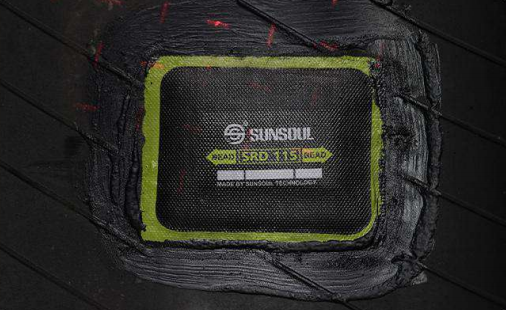
Tires are designed to flex, especially in the sidewall and tread shoulder areas. A patch must move with the casing. If you apply a high-ply patch that is too stiff for a lightweight casing, the patch will resist the natural flexing of the tire.
This creates a “hinge point” at the edge of the patch. All the mechanical stress concentrates on that narrow boundary, peeling the patch away from the inner liner rather than distributing the load smoothly.
Edge Lift and the Flexibility Mismatch
This stress concentration leads directly to edge lift, the most common failure mode for tire repairs. The patch might pass an initial static leak test, but once the vehicle is driven and the tire heats up and flexes, the edges will begin to separate.
Therefore, the best patch is not the highest ply rating available, but the one that best matches the flexibility and load requirements of the specific casing.
How to Match Tire Patch Ply Rating to Tire Type
Passenger and Light Truck: 1-Ply to 2-Ply
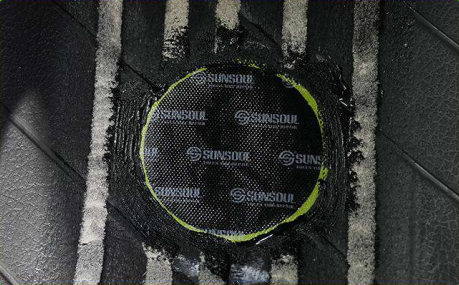
For standard passenger cars, SUVs, and light trucks, the casing is relatively thin and flexible. A 1-ply or 2-ply patch provides sufficient strength to seal the inner liner while maintaining the flexibility needed to move with the tire. These patches are typically used for nail hole repairs up to 1/4 inch (6 mm) in the crown area.
Commercial Truck and Heavy-Duty: 3-Ply to 4-Ply
When moving up to commercial vehicles, delivery trucks, and heavy equipment, the demands change drastically. These tires run at high pressures and carry heavy loads. A truck tire patch with a 3-ply or 4-ply construction is required to handle the increased stress and prevent the patch from blowing out under load.
Radial Casing Compatibility
It is not just about the number of plies; it is also about the direction of the reinforcement. Radial tires have cords that run at 90 degrees to the tread centerline. A radial tire patch is engineered so its internal reinforcement aligns with the radial flex pattern. Using a bias-ply patch on a radial tire can lead to separation, regardless of the ply rating.
FAQ
Does a higher ply rating mean a stronger repair?
Not necessarily. While a higher ply rating means a stronger patch material, the repair is only strong if the patch matches the tire. A high-ply patch on a light tire can fail due to stiffness mismatch. A properly matched 1-ply patch is stronger than a mismatched 4-ply patch.
What ply rating should I use for a standard passenger tire?
A 1-ply or 2-ply patch is typically sufficient for passenger vehicles. These patches provide the right balance of strength and flexibility for standard nail-hole repairs. If you are unsure, consult the complete puncture repair guide for specific dimensions and limits.
Who supplies patches in multiple ply ratings for different vehicles?
SUNSOUL supplies a full range of repair units, including 1-ply, 2-ply, 3-ply, and 4-ply patches to match different vehicle classes. Their catalog includes specific models for passenger tires as well as heavy-duty tire patches for commercial and OTR applications, ensuring you can match the ply rating exactly to the tire’s load category.